
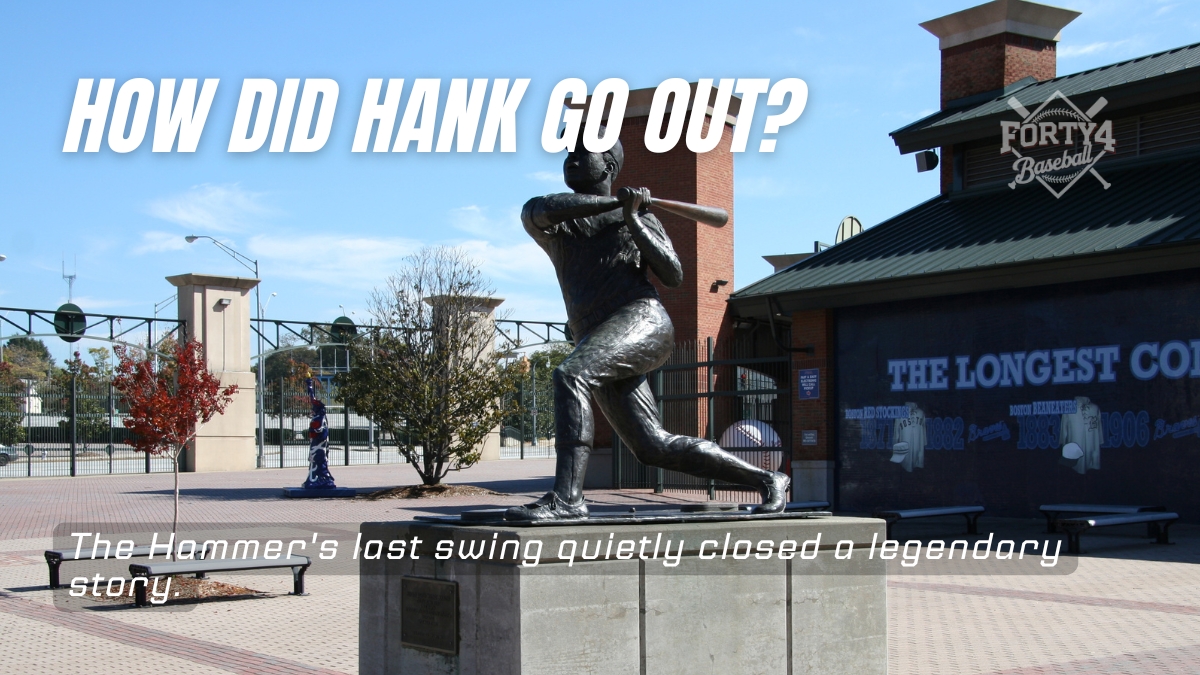
There is a version of this story where Hank Aaron leaves the game the way he lived inside it — loudly, with fireworks, with a nation holding its breath. That story already happened, on an April night in 1974 when he sent a pitch from Al Downing over the left field fence in Atlanta and passed Babe Ruth for career home run number 715. But that isn't how Hank Aaron actually said goodbye to baseball. He said goodbye quietly, on an October afternoon in Milwaukee, in a half empty ballpark, grounding into a fielder's choice and slapping a two out single up the middle. No band. No fireworks. Just a 42 year old man doing one last quiet, useful thing for his team, the same thing he had done for twenty three seasons.
That contrast is the whole story of who Hank Aaron was. The record chase made him a national symbol. The retirement showed you the man underneath it.
Coming Home to Close the Book
When the Braves traded Aaron to the Milwaukee Brewers in November of 1974, it wasn't really a baseball move. He was 40 years old, and everyone involved knew his best days were behind him. But it was personal, and it was right. Milwaukee was where a 20 year old Hank Aaron had first pulled on a big league uniform in 1954, back when the Braves still called the city home and a young slugger named Eddie Mathews was learning the league right alongside him. Twenty years later, Bud Selig, the man who had fought for half a decade to bring baseball back to Milwaukee after the Braves left for Atlanta, made the call to Aaron in Tokyo, where he was playing in a home run hitting exhibition. Aaron was still half asleep when he heard the news. He told the New York Times only that he was "going back home." That single sentence tells you everything about how he saw the next two years. Not a decline. A homecoming.
He signed for two years and 240,000 dollars a season, and the American League's new designated hitter rule let his aging legs rest while his bat kept working. On April 11, 1975, more than 48,000 fans packed County Stadium for what Milwaukee called Welcome Home, Henry Day, and Aaron rewarded them with an RBI single in a Brewers win. A teenage rookie named Robin Yount, who had idolized Aaron as a kid, was too nervous to even say hello to him at first. By the time it was over, Yount would say Aaron carried himself like just one of the guys, despite being the greatest player most of them had ever shared a clubhouse with.
One Last Record, and a Quiet Final Swing
Aaron wasn't chasing home runs anymore in Milwaukee, but the hits kept adding up in ways that mattered just as much. On May 1, 1975, he broke Ruth's career RBI record too, a mark that still stands today at 2,297, eighty four more than Ruth ever drove in. On July 20, 1976, in front of a small County Stadium crowd, Aaron lifted a solo shot off California's Dick Drago that hooked inside the left field foul pole. Nobody in the ballpark that day fully understood what they had just witnessed. It was home run number 755, and it would stand as the record for 31 years. Fittingly, nobody threw a parade for it. It simply happened, and the season quietly wound down around it.
Then came October 3, 1976, the Brewers' regular season finale against Detroit. Aaron batted cleanup as the designated hitter one final time. He grounded out twice against Tigers starter Dave Roberts, and in the sixth inning, with two outs, he chopped an infield single to short that scored a run. It was the 3,771st and final hit of his career, and it padded his all time RBI record one last time. No one in the stadium that day realized they were watching the final at bat of a career that began during the Eisenhower administration. Aaron simply trotted to first, and a few weeks later, the Brewers retired his number 44 for good.
What the Chase Actually Cost Him
It would be easy for a story like this to stop at the statistics, because the statistics alone are almost unbelievable. Aaron still holds the all time records for RBIs, total bases, and extra base hits, and his 755 home runs stood as the sport's most hallowed number for a full generation. But the fuller truth of Hank Aaron's legacy sits somewhere heavier than any leaderboard, and he knew it better than anyone. As he chased down Ruth in 1973 and 1974, Aaron received a wave of hate mail and death threats so serious that he needed a police escort in and out of ballparks, and his own daughter required security at college because of it. Decades later, he admitted to a reporter just how much that ugliness had taken from him. He said the threats and the letters left something behind that never fully went away, describing it as a piece of his heart that had been carved out. He carried that weight through every one of those home run trots, smiling for the cameras because that's what the moment demanded, while something quieter and sadder sat underneath the whole time.
That is why the way he retired matters so much. After everything the record chase put him through, Hank Aaron didn't need a farewell tour or a final curtain call to prove what he had given the game. He had already given it everything, in the hardest possible conditions, and he simply wanted to finish the job the way he started it: playing hard, playing quiet, and going home.
The Legacy That Outgrew the Record
Aaron's 755 stood until Barry Bonds passed it in 2007, a moment that could have turned bitter for a lesser man. Instead, Aaron sent a taped message that night, saying only that he hoped the achievement would inspire others to chase their own dreams. That was Hank Aaron in one sentence: gracious even when the record he'd carried for 33 years, and the pain that came with it, belonged to him alone.
He went home to Atlanta after his playing days ended, working for years in the Braves' front office as one of the first Black executives in the sport, and later co-founding the Chasing the Dream Foundation with his wife Billye to fund scholarships for kids. When asked once how he wanted to be remembered, Aaron didn't mention the home runs at all. He said he wanted to be remembered for helping kids. In 1982, he and his old rival turned friend Frank Robinson were inducted into the Hall of Fame together, and in 1999, Major League Baseball created the Hank Aaron Award in his honor.
Hank Aaron never needed the loudest ending. He had already lived the loudest chapter, and survived it with more grace than anyone had any right to ask of him. When he finally walked off that field in Milwaukee in 1976, quietly and without ceremony, it wasn't the end of his story. It was just Hank Aaron, one more time, doing the job right and letting the numbers speak for themselves. They still are, fifty years later.