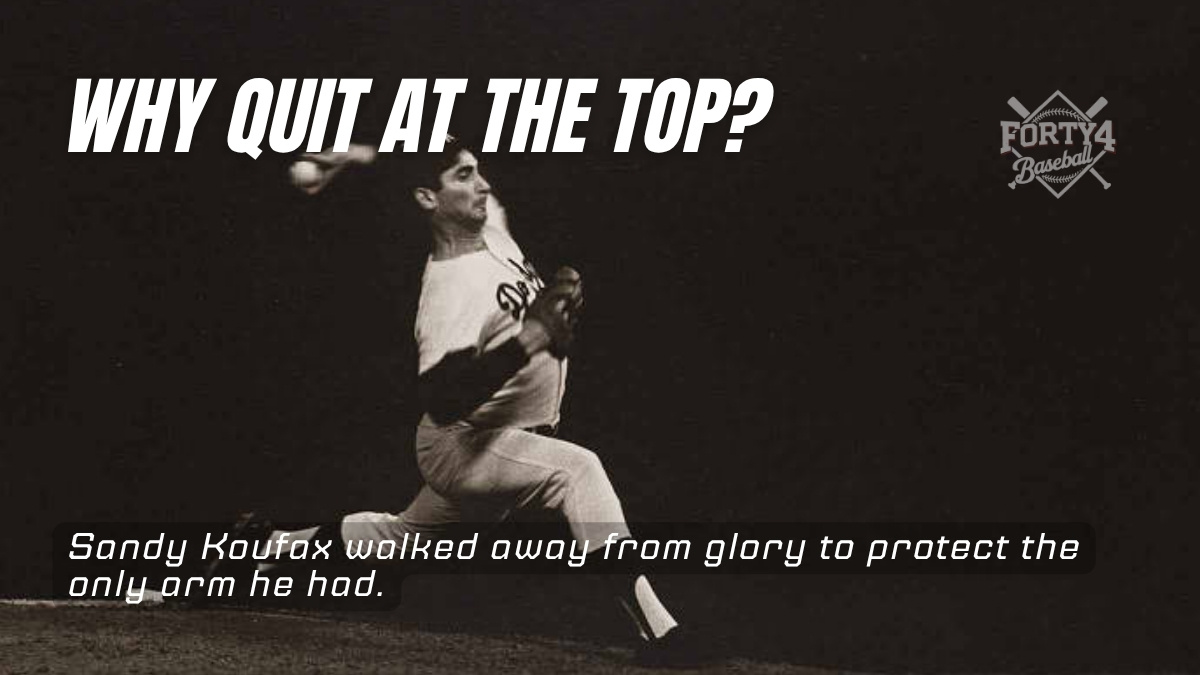
There is a particular kind of courage in walking away from something while you are still the best in the world at it, and on November 18, 1966, Sandy Koufax showed baseball exactly what that courage looked like. He was 30 years old. He had just finished a season in which he went 27 and 9, led the league in earned run average for the fifth straight year, and won his third Cy Young Award, all of it unanimous. Every general manager in baseball would have handed him a blank contract. Instead, Koufax stood in front of reporters and told them, in the calm, matter of fact way he always spoke, that he was done. Not because his talent had faded. Because his body had quietly begun sending him a warning that no amount of glory was worth ignoring.
That decision, more than any no-hitter or shutout, may be the truest measure of who Sandy Koufax really was.
A Career Built on Borrowed Time
It is easy to forget, looking back at the numbers, just how much pain sat underneath Koufax's dominance in those final seasons. His elbow had been quietly deteriorating since 1964, when an awkward slide into second base aggravated an already fragile joint and ended his season early that August. By 1965 and 1966, the arthritis had become something closer to a daily negotiation with his own body. He soaked his pitching arm in a skin scorching ointment called Capsolin before nearly every start, just to loosen it enough to throw. He took cortisone shots between outings and swallowed anti-inflammatory medication originally formulated for racehorses. The damage was severe enough that his left arm had physically shortened compared to his right, forcing him to have his suit jackets specially tailored just to hide the difference. Dodgers physician Dr. Robert Kerlan put it about as plainly as a team doctor ever has, saying that Koufax pitched in extreme pain that only his own drive could overcome.
And still, somehow, batters simply could not touch him. Willie Stargell famously said that trying to hit a Koufax fastball felt like trying to drink coffee with a fork. Yogi Berra, never short on a good line, once joked that he understood exactly how Koufax won 25 games in a season, what puzzled him was how he ever lost five. On September 9, 1965, at the peak of all that hidden suffering, Koufax threw a perfect game against the Cubs, striking out 14 batters in a performance so dominant it barely seemed to belong to the same sport everyone else was playing. A month later, on just two days of rest, he took the ball in Game 7 of the World Series against the Twins and delivered a complete game shutout to win the championship, pitching almost entirely on nerve and history's most famous left arm held together by little more than willpower.
Choosing Tomorrow Over One More Trophy
By the fall of 1966, though, something had shifted. Koufax later admitted that there was barely a single game that entire season when his arm did not hurt in some fashion. He had started to think seriously about what his life might look like after baseball, and more specifically, whether he would even have full use of his own hand by the time he got there. There was no surgical fix available in 1966 the way there would be for future generations of pitchers. Going under the knife back then meant almost certainly ending a career on the spot, without any guarantee of getting the injury properly repaired. Koufax weighed all of it with the same clear headed honesty that had always defined him, and he came to a conclusion that shocked the sports world precisely because it ran against every instinct professional athletes are taught to have.
He said it best himself, in words that still carry weight six decades later. He explained that he did not regret one single minute of the twelve years he had spent in the game, but that he could very easily regret playing one season too many. He said he had a great many years left to live after baseball ended, and that he wanted to live every one of them with the complete use of his own body. It is a strikingly modern sentiment, one that predates by decades the current era of load management and career longevity science, arriving instead from a lone Brooklyn born lefty who simply refused to gamble his future for one more standing ovation.
A Legacy Built on What He Refused to Give Away
Koufax's retirement rippled outward in ways that went well beyond his own career. He and teammate Don Drysdale had already challenged the sport's power structure the year before, staging a joint holdout that pushed back against how little control players had over their own value, a moment historians now point to as an early spark of baseball's labor movement. His decision to protect his own body, rather than sacrifice it for one final payday, quietly reshaped how athletes and franchises alike began to think about the true cost of playing through injury. Decades before teams routinely shut healthy stars down to protect their future, Koufax had already made the case in the most convincing way possible, by walking away himself.
What came after was equally telling. Koufax never chased the spotlight his legend could easily have afforded him. He mostly stayed out of the public eye, coached quietly, and let his statistics and his choices speak for whatever needed saying. In 1972, at just 36 years old, he became the youngest player ever elected to the Baseball Hall of Fame, a distinction he still holds more than fifty years later. It remains a fitting tribute to a man whose entire legacy was built on knowing exactly when enough was enough. Sandy Koufax gave baseball five of the most electric seasons any pitcher has ever thrown, and then, at the height of it all, he gave himself something even rarer: a future worth having.