
Mickey Mantle only had one career, but he gave baseball two goodbyes, and they could not have looked more different from each other. The first came on March 1, 1969, in a hotel room overlooking the Atlantic, when a 37 year old Mantle stood in front of reporters and admitted, in the plainest language imaginable, that his body had simply stopped cooperating with his talent. The second goodbye came twenty six years later, in a Dallas hospital auditorium, from a man who had already lived an entire lifetime beyond the ballplayer everyone thought they knew. Both moments broke hearts. Only one of them may have actually saved lives.
That is the real, complicated shape of Mickey Mantle's legacy, and it deserves to be told in full.
Walking Away From the Only Thing He Knew
By the time Mantle retired, his body had been betraying him for nearly two decades. He tore up his knee in Game 2 of the 1951 World Series, his rookie season, catching his cleat on a drainage cover while chasing a fly ball, and he never ran the same again. Every season after that became an exercise in quiet endurance, playing through pain that would have benched an ordinary player for a month. He did it anyway, well enough to win the Triple Crown in 1956, well enough to break Babe Ruth's World Series home run record with a walk off shot in the 1964 Fall Classic, well enough to become the sixth player in history to reach 500 career home runs in 1967. Teammate Carl Yastrzemski once said watching Mantle swing late in his career, legs buckling with every stride, felt like watching your own kid get hurt.
When Mantle finally stood at that Fort Lauderdale press conference in March of 1969, he did not dress it up. I can't hit the ball when I need to, he told reporters, I can't steal when I need to, I can't score from second when I need to. There is no use trying. It was the same honesty that had always made him beloved, stripped of any pretense that he had anything left to prove.
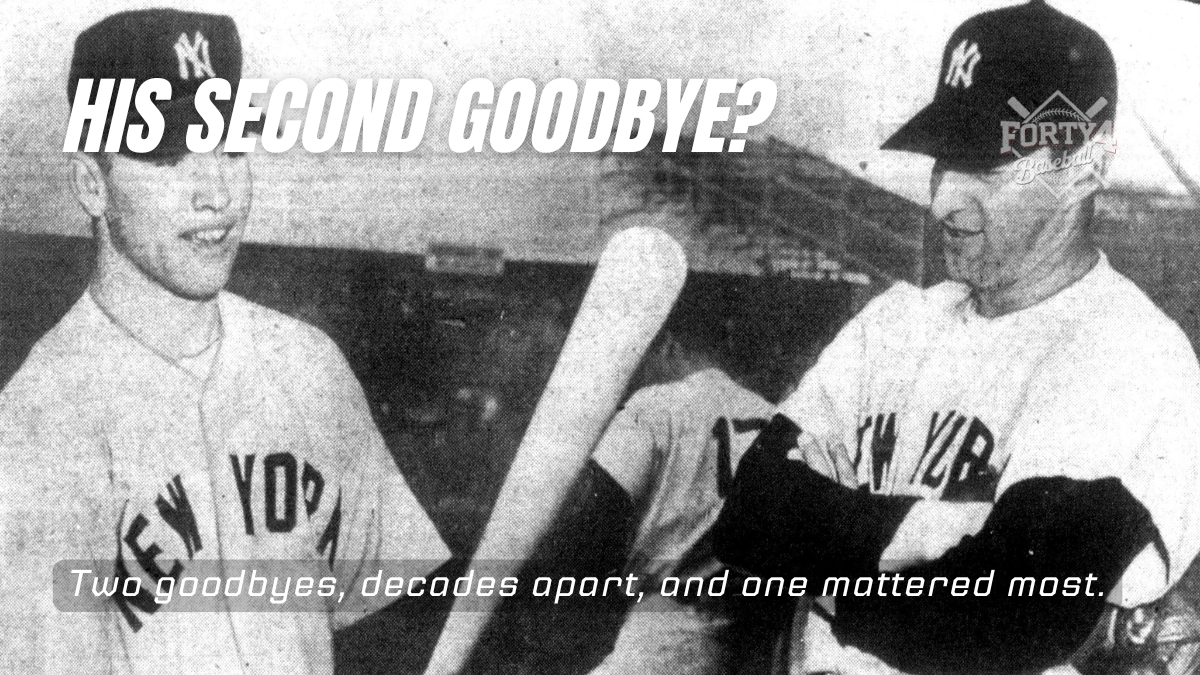
The Yankees gave him a proper sendoff three months later. On June 8, 1969, Mickey Mantle Day drew 61,000 fans to Yankee Stadium, where Joe DiMaggio presented him with a plaque for the center field wall, and Mantle, in typical fashion, insisted DiMaggio's own plaque hang one inch higher than his. Overcome, Mantle stood at the microphone for nearly ten minutes before he could speak, and when he finally did, he reached for the most famous farewell in the sport's history. He said he had always wondered how a man who knew he was dying could stand up and call himself the luckiest man alive, but that now, finally, he understood exactly how Lou Gehrig felt. Then he climbed into a golf cart painted in pinstripes and rode a full lap around the warning track while the crowd stood and roared for a man who could no longer run those same bases himself.
It was a beautiful ending. It was not, however, the last time Mickey Mantle would have to say goodbye to something bigger than baseball.
The Goodbye Nobody Saw Coming
What most fans did not know in 1969 was how much Mantle was already struggling behind that easy Oklahoma grin. His drinking, present for years, only grew worse once the game that had organized his entire life disappeared. He later admitted the emptiness left by walking away from teammates like Whitey Ford and Billy Martin drove him further into the bottle, not away from it. For decades, the public mostly saw the charming, aging legend at old timers games and memorabilia shows. They did not see the mornings that started with what he darkly called his breakfast of champions, or the blackouts, or the family unraveling quietly behind the fame.
By 1994, three of his four sons were also fighting alcoholism, and Mantle finally admitted to himself what everyone around him had been begging him to see for years. He checked into the Betty Ford Center that January, and for the first time in his adult life, got sober. He wrote a letter to his long dead father. He told his sons he loved them, every single conversation, something he had almost never done before. It seemed, for a moment, like the start of a genuinely new chapter.
Then his liver, ravaged by decades of alcohol, hepatitis, and cirrhosis, finally gave out. Mantle received an emergency transplant on June 8, 1995, twenty six years to the day after Mickey Mantle Day at Yankee Stadium. Weeks later, gaunt and visibly weakened, he stood at a podium at Baylor University Medical Center for what would be his final public appearance. He could have talked about his home runs, his Triple Crown, his plaque in Monument Park. Instead, he looked directly into the cameras and told the country something no legend particularly wants to say about himself. He said God had given him a body and the ability to play baseball, and that he had wasted it. He told parents that they, not ballplayers, should be the role models their children needed. Then he said the four words that would end up defining the rest of his story: don't be like me.
Mickey Mantle died two months later, on August 13, 1995, at the age of 63. But that final press conference outlived him in a way his home runs never quite could on their own. It was, by his own son's account, the truest version of Mickey Mantle the public ever got to see, a man finally done performing for anyone, telling the plain truth one last time because he understood, at the very end, just how much that truth might matter to someone else.
Two Goodbyes, One Legacy
Baseball fans will always remember Mickey Mantle for the towering home runs that seemed to defy the laws of physics, for a swing so pure from either side of the plate that pitchers genuinely feared him no matter which way he stood. That memory deserves every bit of its glory. But the fuller portrait of the man includes both of his goodbyes, the graceful one in 1969 and the painfully honest one in 1995, and it is worth remembering that the second one took a kind of courage the first one never demanded of him. Walking away from baseball meant admitting his knees were gone. Walking away from his own myth meant admitting that the golden boy everyone adored had, by his own account, wasted something precious. Mickey Mantle gave the game two farewells. Together, they tell the story of a legend who was, in the end, simply and remarkably human.