
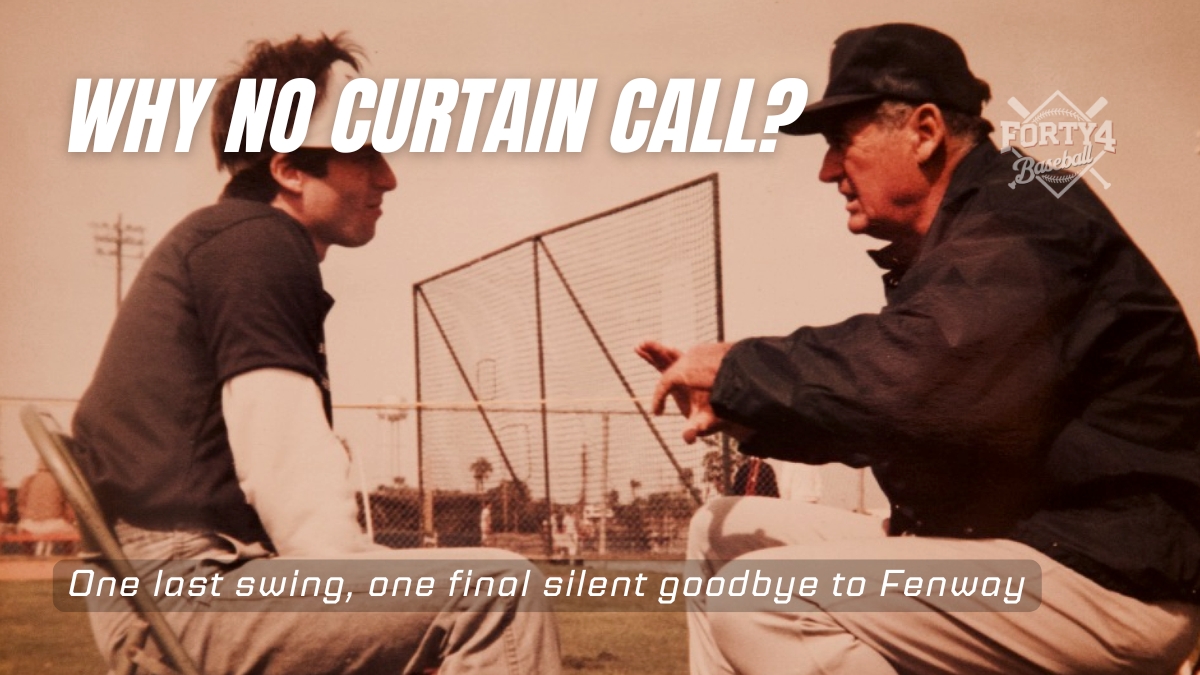
There is a sound old Fenway Park makes when thousands of people all rise at once and refuse to stop clapping. It happened on September 28, 1960, in the eighth inning of an otherwise meaningless late season game, and it happened because Ted Williams had just done something almost nobody believed a 42 year old ballplayer with a stiff back had any business doing. He turned on a fastball from Baltimore's Jack Fisher and sent it soaring over the Boston bullpen, his 521st career home run, in the very last at bat of his career. And then, in true Ted Williams fashion, he refused to give the crowd a single thing more. No cap tip. No curtain call. Just a young left fielder's stubborn, private pride, worn all the way to the end.
That single moment tells you almost everything you need to know about the man they called the Splendid Splinter.
A Career Built on Doing It His Own Way
Ted Williams arrived in Boston in 1939 as a gangly 20 year old kid from San Diego with a swing so pure that Babe Ruth himself supposedly declared him the best rookie in the league before the season even ended. Nobody who watched him hit ever forgot it. He studied the science of hitting the way other men studied scripture, obsessing over the strike zone pitch by pitch, inning by inning, decade by decade, chasing a standard of perfection that most hitters never even think to dream about. He wanted, in his own words, to walk down the street one day and have people say there goes the greatest hitter who ever lived. By the time he was through, it was hard to argue he hadn't earned exactly that.
He won two Triple Crowns. He led the league in batting average six times, and he still holds the highest career on base percentage in the history of the sport. And of course there was 1941, the season every serious fan of this game still brings up with something close to reverence, when Williams refused to sit out a season ending doubleheader to protect a rounded up .400 average, went out and played anyway, and finished at a flat .406. No one has hit .400 since. Eighty five years later, nobody has come particularly close.
But the numbers were never the whole story with Ted Williams, because greatness like his always seems to come bundled with something harder and more complicated underneath it. Williams had a famously prickly relationship with the Boston press and, at times, with the very fans who adored him. Booed early in his career for a perceived lack of hustle, he made a private vow never to tip his cap to the Fenway crowd again, and he kept that vow with a stubbornness that bordered on the mythic. It is the kind of thing that could make a lesser athlete look petty. With Williams, somehow, it only made him more magnetic. He was not going to perform gratitude he didn't feel just to make anyone comfortable, and there was something almost admirable in a man who refused to bend, even for applause he clearly wanted.
The Swing That Needed No Encore
By 1960, the baseball world assumed Williams was done. He was 42, coming off a miserable, injury shortened 1959 season, and Red Sox management gently suggested he consider retirement. Williams, characteristically, was too proud to walk away on a down note, so he came back for one more year and hit .316 with 29 home runs, an OPS that would have made players half his age jealous. When the Red Sox played their final home game of the season against Baltimore, word had already spread that it would be Williams's last appearance at Fenway. Only 10,454 fans showed up, a strange, sparse crowd for a farewell of this magnitude, a reminder of just how complicated the city's feelings toward him had always been.
Then, in the eighth inning, he hit the home run that ended it all. The novelist John Updike happened to be in the stands that day, and he turned the moment into one of the most celebrated pieces of sportswriting ever put on paper, describing the crowd's reaction as a kind of hushed, reverent roar, one that seemed to carry every memory of Williams's twenty one summers in a Red Sox uniform all at once. Teammates begged him from the dugout to come out and tip his cap. Williams jogged the bases with his head down, exactly as he always had, and simply sat back down on the bench. Manager Pinky Higgins sent him out to left field to start the next half inning purely so the fans could give him one final ovation before quietly pulling him for a defensive replacement. Williams never did remove that cap. He never got the chance to grace the road trip finale in New York either, choosing to end his career at Fenway rather than play out three meaningless games away from home. The kid, as Updike so memorably called him, said goodbye on exactly the terms he chose, and not one inch beyond them.
A Legacy That Outgrew Even the Swing
What makes Ted Williams's story so much more than a beautiful ending, though, is everything that surrounded it. This was a man who walked away from the top of his sport not once but twice, first to fly combat missions as a Marine pilot in the Pacific during World War II, and then again during the Korean War, where he flew dozens of missions as a wingman to a young aviator named John Glenn. He gave up what likely would have been three or four more monster seasons, seasons that might have pushed his career home run total into rarified territory, and he never once treated it as a sacrifice worth complaining about. It was simply what he believed a citizen owed his country.
He carried that same quiet sense of duty into his relationship with the Jimmy Fund, the Boston based charity supporting children with cancer that Williams championed for decades, visiting sick kids in hospitals long before it was fashionable for athletes to do that kind of thing, usually without a camera anywhere nearby. And when Cooperstown called his name in 1966, Williams used his own induction speech, a moment plenty of legends would have spent simply basking in personal glory, to challenge baseball to open its doors to the great Negro League players who had never been given a fair chance to prove themselves on the same stage. It took the Hall of Fame five more years to act on it, but Williams had said his piece, publicly and unmistakably, at the exact moment the entire baseball world was listening.
That was always the real Ted Williams underneath the batting stance. Stubborn, yes. Impossibly proud, without question. But guided by a code that mattered more to him than any ovation, any headline, any curtain call. He never tipped his cap that September afternoon in 1960, and in a strange way, that refusal has become the most fitting tribute imaginable. Ted Williams never needed Fenway's applause to know exactly who he was. The swing had already told everyone everything they needed to know.