There is a particular kind of heartbreak in watching a legend's body finally give out in front of the whole country, and Willie Mays lived through that heartbreak in the fall of 1973, in the World Series, under the lights he had once owned like nobody else in the game's history. He was 42 years old, playing on knees that no longer cooperated, and twice in that Series he lost routine fly balls in the sun, stumbling after them the way ordinary outfielders do, not the way Willie Mays was supposed to move. It was jarring precisely because it was so unfamiliar. This was the same man who, twenty years earlier almost to the day, had run down a ball no human being should have been able to reach, glove turned backward, cap flying off, in a play that baseball still simply calls The Catch. Now here he was, squinting into a September sun, watching a ball drop that once would have found its way into his glove without a second thought.
Mays knew exactly what was happening, and he said so out loud, with a bluntness that still lands hard fifty years later.
An Honest Goodbye From a Proud Man
When Willie Mays came back to New York in a May 1972 trade with the Mets, it was framed as a storybook homecoming. He had been the toast of the city two decades earlier with the Giants, playing stickball with neighborhood kids between games and turning the Polo Grounds into his personal stage. Mets owner Joan Payson had promised herself she would bring Mays back to New York before his career ended, and in 1972, at 41 years old, he finally came home. But the storybook ending never quite arrived. Mays hit only a handful of home runs across his year and a half with the Mets, and by September of 1973, he was batting a painful .211. Rather than let the decline drag on, Mays made the call himself. On September 20, 1973, on national television, he announced he would retire once the season ended, and later that day, at a Shea Stadium press conference, he explained his reasoning with a kind of honesty legends rarely allow themselves. He said plainly that when you're forty two and hitting .211, it stops being fun, and that the people of America shouldn't have to watch a guy play who can't produce.
Few athletes have ever said something that true about themselves in public. It would have been easy for Mays to hang on another year chasing one more moment of magic. Instead, he chose to walk away with his own diagnosis, delivered without flinching, before anyone else could write it for him.
The Mets still found a way to make his final months feel like a celebration. On September 25, 1973, Shea Stadium hosted Willie Mays Night, packed with baseball royalty including Joe DiMaggio, Stan Musial, and Duke Snider, along with former Giants teammates like Bobby Thomson, who had shared the field with a young, electric Mays back in 1951. Gifts poured in from every direction, cars and plaques and even an honorary college degree, a fitting tribute to a career that had already secured its place among the greatest the sport has ever produced. Then came October, and that difficult World Series against Oakland, where Mays played sparingly, stumbled in the sun, and grounded into a fielder's choice as a pinch hitter in what turned out to be the final at bat of his career. There was no storybook final swing. His teammate Cleon Jones would later say he couldn't think of anyone besides Babe Ruth who brought more to the game than Willie Mays, and that even at 42, with a knee full of fluid, you could still occasionally glimpse the player he used to be.
The Promise Nobody Forgot
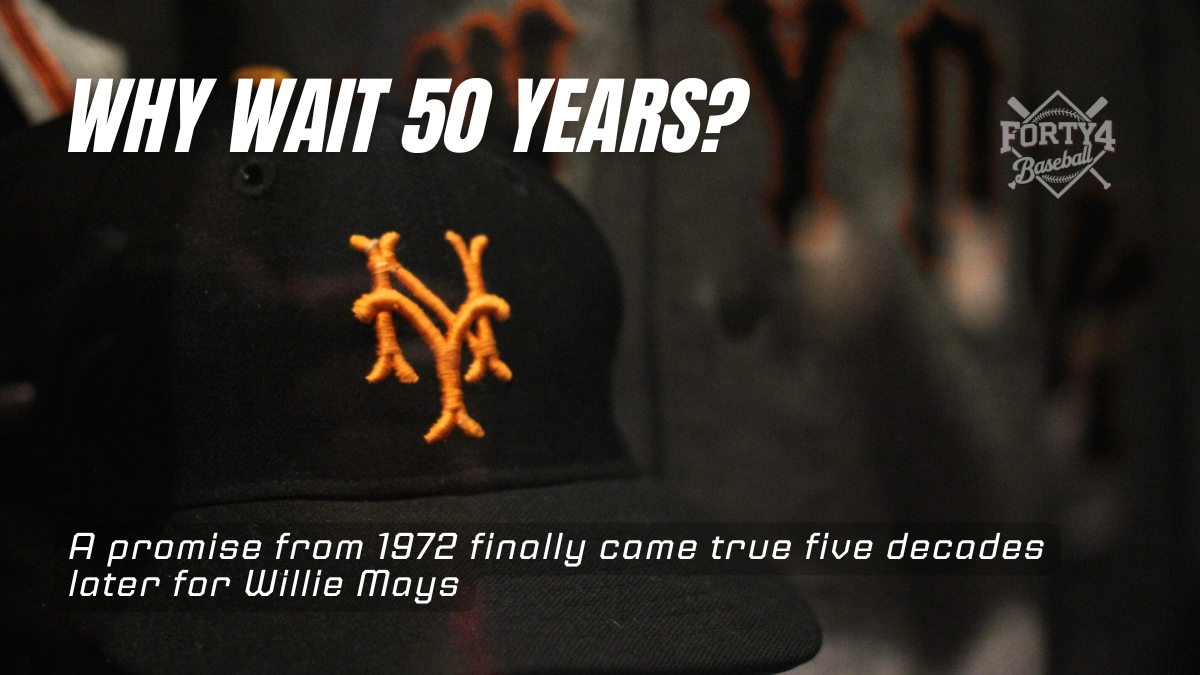
Here is the part of the story that gives Willie Mays's retirement its real, lasting shape. Before he ever suited up for the Mets, Joan Payson had privately promised him that the organization would one day retire his number 24 in his honor. She died in 1975, only two years after his career ended, and the promise seemed to quietly disappear along with her. Mays kept playing his part in Mets history as a coach for several years afterward, but the number retirement never came. Decades passed. Generations of fans who had never seen him play grew up hearing about The Catch only through grainy footage and their grandparents' stories.
Then, on August 27, 2022, at Citi Field's Old Timers' Day, nearly fifty years after Payson made her promise and forty seven years after her death, Mets owner Steve Cohen finally made it official, retiring number 24 in a surprise ceremony that closed a loop the baseball world had assumed was permanently open. Mays's son Michael was there to see it, and later described just how much that fulfilled promise meant to his father, calling it the moment that finally, fully secured Willie Mays as a Met for good. It was not a tribute to his statistics in New York, which were modest at best. It was a tribute to everything Willie Mays had given the sport across 22 remarkable seasons, honored at last in the city where both the beginning and the ending of his playing career had unfolded.
Willie Mays died in June of 2024 at the age of 93, having lived long enough to see that half century old promise finally kept. His retirement in 1973 was never going to be the tidy, storybook exit his talent seemed to deserve. But the honesty he showed walking away, admitting plainly that his body could no longer keep up with his legend, turned out to be exactly the kind of grace that made people love him even more. Baseball does not always get its endings right the first time. Sometimes it simply takes fifty years, and the right owner, to finally get it right.