
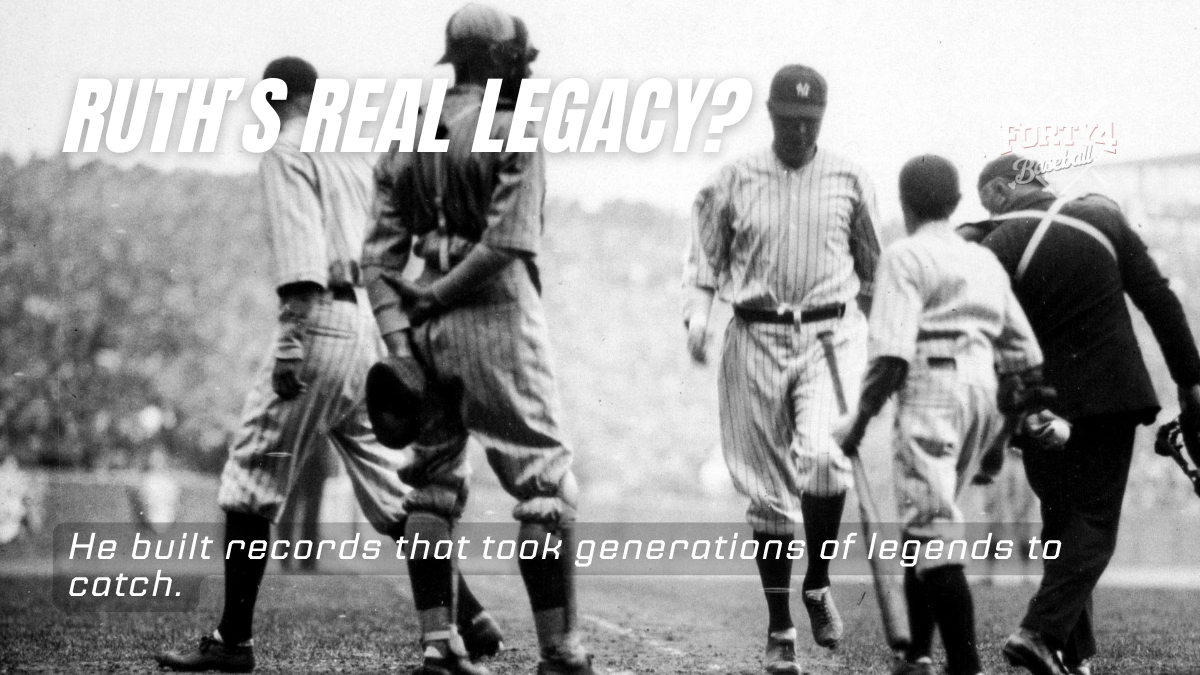
When Babe Ruth retired in 1935, he did not simply leave the game. He left behind a set of numbers so enormous that baseball assumed, almost as a matter of faith, that no one would ever touch them. That is the part of Ruth's retirement worth sitting with. His career did not end with a bow or a farewell tour that mattered much at the time. It ended with him planting a flag on a mountain so tall that it took entire generations of legends, one after another, just to find a foothold.
That is a legacy. Not a moment. A mountain.
A Kid Who Wasn't Supposed to Hit
It is worth remembering that Ruth did not arrive in the majors as a slugger at all. He debuted for the Boston Red Sox on July 11, 1914, as a 19 year old left handed pitcher, and for his first several seasons that is exactly what he was, an exceptional one at that. He won 23 games in a season, set a World Series record for consecutive scoreless innings that stood for decades, and looked every bit like a future Hall of Fame arm. Nobody in that Red Sox clubhouse could have guessed that the same left arm would eventually reshape the entire sport with a bat instead.
Everything changed once Ruth started hitting, and hitting like nobody had before him. When the Yankees purchased his contract from the Red Sox on January 5, 1920, in a deal that would haunt Boston for generations, Ruth stopped being merely a great player and became something closer to a weather system. He hit 54 home runs that first season in pinstripes, more than entire teams managed some years, and baseball simply had no framework yet for what it was watching. By 1927, wearing that unmistakable number 3, Ruth hit 60 home runs in a single season, a mark so far beyond anything else in the sport that most assumed it would stand forever. Two years later, on August 11, 1929, he became the first player in history to reach 500 career home runs, a milestone nobody else would touch for another eleven years. And in the 1932 World Series, he delivered the single most debated moment in baseball history, pointing toward the outfield before launching a home run to that exact spot, a legend that baseball has argued over for nearly a century since.
The Mountain Nobody Could Climb
Here is what actually makes Ruth's legacy so staggering, though. It is not simply that he set these records. It is how long they stood, and what it took to finally bring them down.
His single season mark of 60 home runs held for 34 years, untouched, unthreatened, treated almost as sacred. It finally fell in 1961, when Roger Maris chased it down over a full extra week of season, hitting his 61st on the final day, in a pursuit so tense that baseball actually debated whether an asterisk belonged next to the new number. Ruth's career total of 714 stood even longer, for 39 years, surviving Ty Cobb, Jimmie Foxx, and Willie Mays, until Hank Aaron finally passed it in April of 1974 while enduring a wave of hatred and death threats that no ballplayer should have ever had to carry. Even then, Ruth's fingerprints never really left the record book. Aaron's chase, and later Barry Bonds's, only underlined just how absurd Ruth's dominance had been in the first place. These were some of the greatest hitters the sport has ever produced, and it still took them the better part of four decades, apiece, just to reach the number Ruth had quietly set and then walked away from.
Numbers alone do not capture it, either. Ruth's career slugging percentage of .690 still stands untouched today, nearly a full century later, in an era of load management, video analytics, and hitters built in weight rooms Ruth could never have imagined. His single season fWAR figures, dating back to the 1920s, remain the highest ever recorded for a position player, three separate times over. Nobody has managed even one season like that since.
The House Built Around One Man
Ruth's impact on the game went beyond the record book, too. He hit the first ever home run at brand new Yankee Stadium on April 18, 1923, in a ballpark that was quite literally constructed with his swing in mind, its short right field porch built specifically to turn Ruth's power into home runs. Sportswriters started calling it The House That Ruth Built almost immediately, and the nickname stuck for good reason. Ruth did not simply play in that stadium. He justified its existence. Attendance records shattered wherever he went, home or away, as fans packed ballparks purely for a chance to watch him swing. Baseball's entire offensive identity shifted around him, from a cautious, small ball era built on bunts and stolen bases into the thunderous, home run driven game the sport still plays today.
That, in the end, is the real story of what Babe Ruth left behind when he retired. Not a farewell moment, not a final at bat worth remembering, but a towering, almost unbelievable standard that reshaped how an entire sport measured greatness for the rest of its history. Every kid who ever stepped into a batter's box dreaming of hitting one out was, whether he knew it or not, chasing a ghost that Babe Ruth left behind nearly a century ago. Some players leave a career. Ruth left a scoreboard the whole sport spent generations trying to catch up to.